























RADIOLOGY
Detects osteoporosis and osteopenia from an X-ray.
Developed in collaboration with Ramón y Cajal University Hospital, quantusOS uses Artificial Intelligence to analyze hip X-rays and identify patients at risk of osteoporosis or osteopenia.

DESCRIPTION
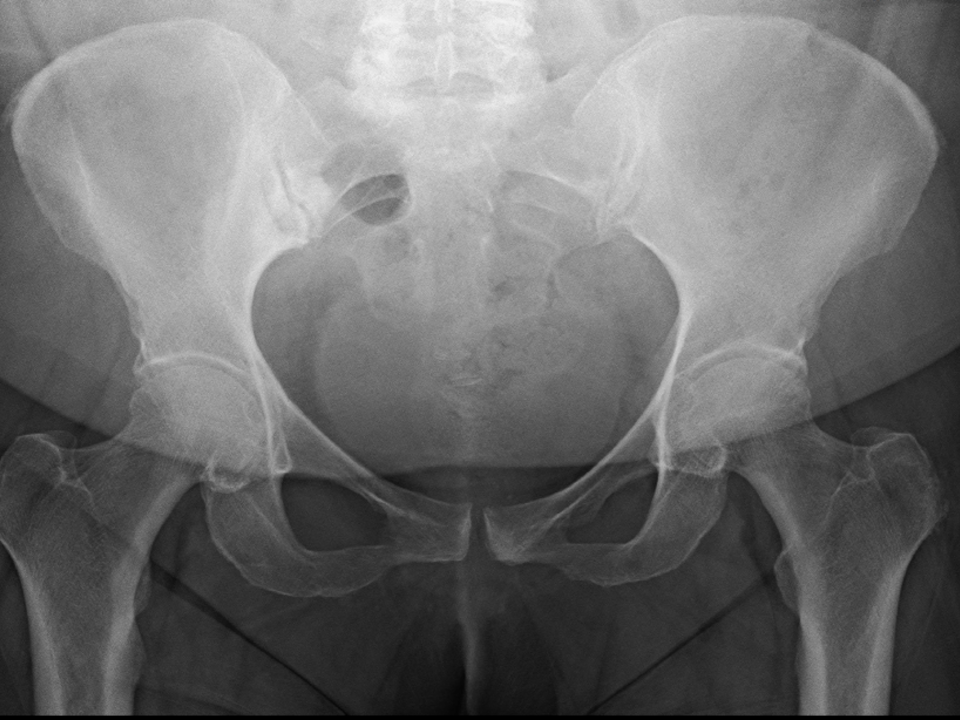
quantusOS is a test for the detection of osteoporosis and osteopenia based on the automatic analysis of a hip X-ray.
It is intended for radiologists and other trained healthcare professionals, and consists of a software medical device (MDSW) that supports clinical decision-making through the analysis of conventional anteroposterior hip X-rays (of one or both sides) of adult patients. It estimates the probability of osteopenia or osteoporosis and returns the result as a predefined risk class (1-5).
The device is designed to be used as a diagnostic support tool; the generated reports assist the healthcare professional’s decision-making.
USE CASES

CU-OS-01: Population Screening in Primary Care
In primary care, the physician orders a routine hip X-ray and quantusOS automatically analyzes the image, providing an osteoporosis risk classification in under 3 minutes to support clinical decision-making.
CU-OS-02: Treatment Monitoring and Follow-up
In patients already diagnosed with osteoporosis and undergoing bisphosphonate treatment, quantusOS analyzes follow-up X-rays to assess the evolution of ossification levels and generate a progression report that helps the specialist personalize treatment adjustments.
CU-OS-03: Integration into Insurers and Health Plans
Insurers can incorporate quantusOS as a screening tool in periodic checkups for people over 50, automatically analyzing X-rays and integrating the results into the insured person’s medical record to facilitate early detection and preventive management of osteoporosis risk.
CU-OS-04: Telemedicine and Rural or Hard-to-Reach Areas
In rural settings or areas with limited access to specialists, quantusOS analyzes X-rays obtained with conventional equipment and sent to the cloud platform, providing an osteoporosis risk assessment within minutes that gives the local physician diagnostic support without needing to refer the patient.

CLINICAL EVIDENCE
Tool for the automatic detection of osteoporosis and osteopenia from a hip X-ray (quantusOS).
The study was carried out in collaboration with Ramón y Cajal University Hospital. The tool created performs five sequential tasks, which include four distinct Deep Learning algorithms:
The system classifies each X-ray into five osteopenia/osteoporosis risk categories, from Class 1 (lowest probability) to Class 5 (highest probability). This classification is based on a series of decision thresholds, each associated with specific values of sensitivity, specificity, positive predictive value (PPV) and negative predictive value (NPV). Thresholds for the lower classes prioritize sensitivity (a Class 1 result makes the condition very unlikely), while those for the higher classes prioritize specificity (a Class 5 result makes it very likely), as shown in the following table:
| Class threshold | Sensitivity | Specificity | PPV * | NPV * |
|---|---|---|---|---|
| Classes 4-5 | 24.5% | 99.1% | 99.4% | 16.5% |
| Classes 3-4 | 49.4% | 95.4% | 98.6% | 22.1% |
| Classes 2-3 | 80.1% | 79.6% | 96.3% | 37.6% |
| Classes 1-2 | 98.9% | 20.4% | 89.2% | 73.3% |
* PPV and NPV (Positive Predictive Value and Negative Predictive Value)

SOLUTION INTEGRATION
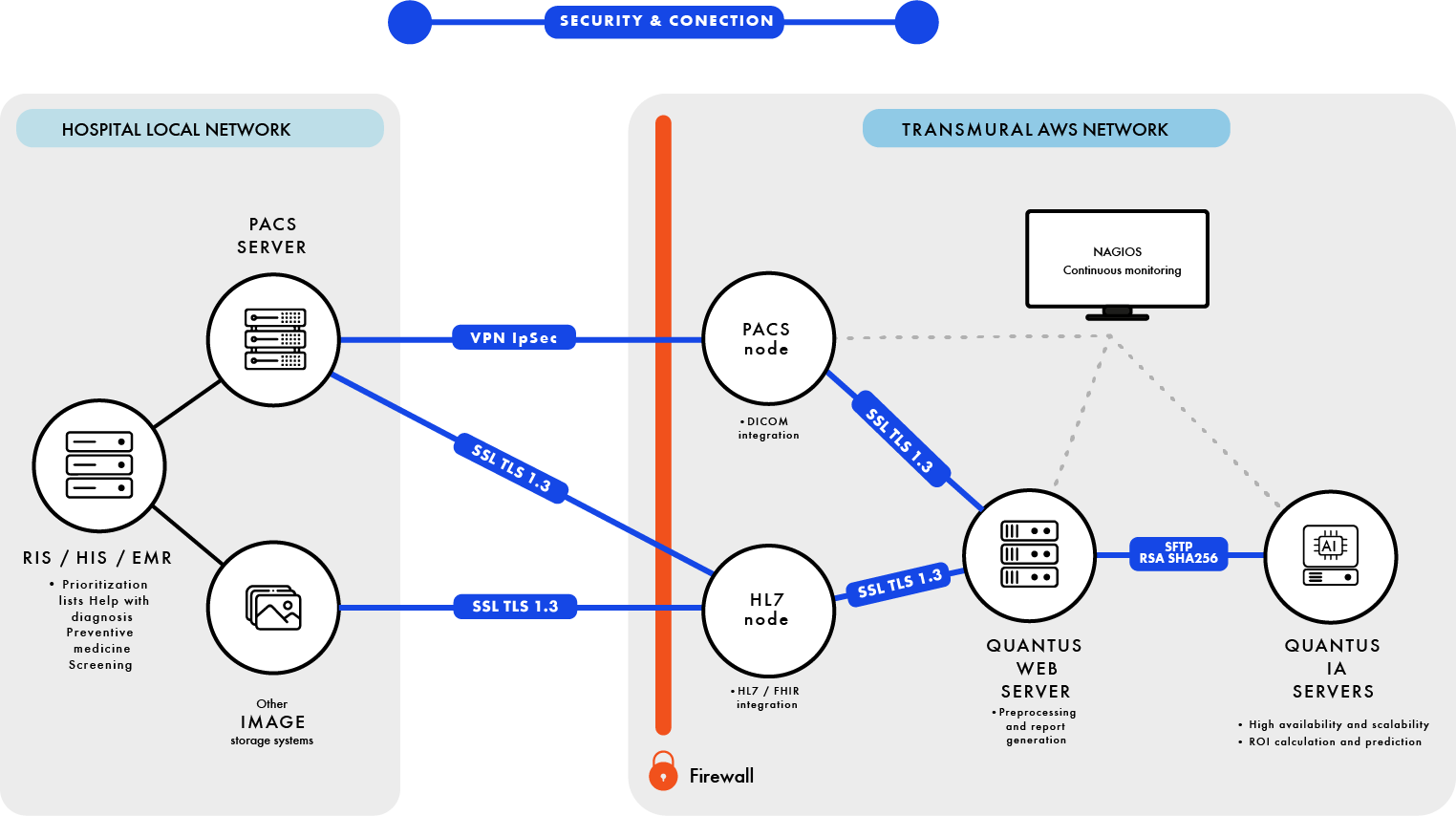
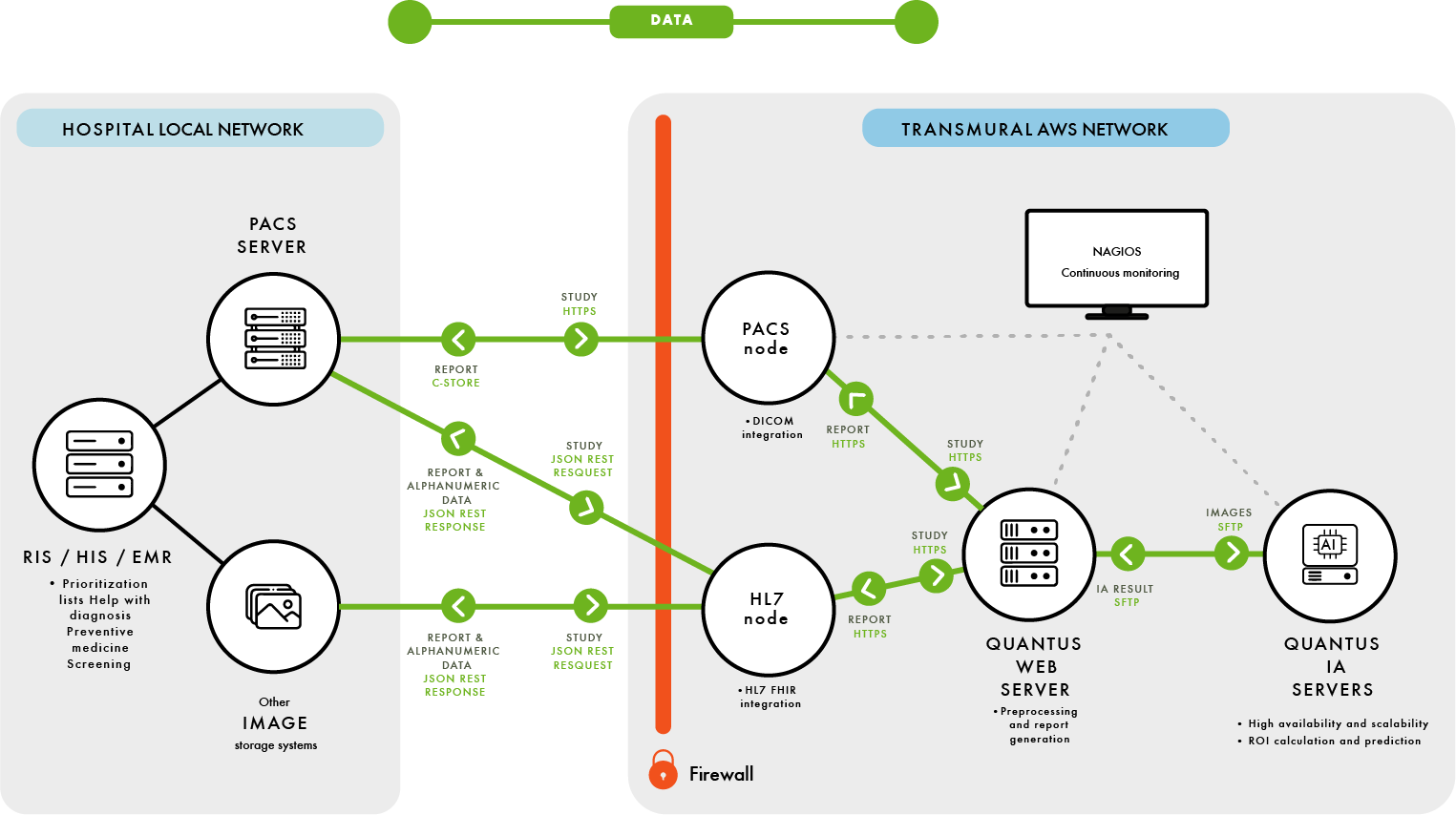
- Our products allow integration with client systems through the DICOM protocol and the HL7 FHIR interface
- We ensure data privacy in SaaS installations by establishing IPsec VPNs with our clients.
- All communications outside the client environment are secured with SSL TLS 1.3

LICENSING BY NUMBER OF TESTS
LICENSING BY ANALYSES PERFORMED
CUSTOM OFFERS


